AI call center software combines contact center tools with artificial intelligence to help teams handle more conversations, resolve issues faster, and deliver consistently high-quality support. Instead of relying solely on manual workflows and agent memory, AI can support every stage of the call: routing, real-time assistance, summarization, quality monitoring, and analytics.
When implemented well, AI does not just automate tasks. It elevates outcomes that matter: higher customer satisfaction, shorter wait times, improved first-contact resolution, and happier agents who spend more time solving meaningful problems and less time on repetitive work—demonstrating omni channel cloud contact center technology redefining engagement with AI contact center solutions.
As part of planning adoption, reviewing AI call center software pricing is essential. Pricing can vary based on features such as virtual agents, real-time agent assist, analytics, and workflow automation, as well as the number of users and interaction volumes. Understanding costs upfront helps organizations make informed investment decisions, scale AI effectively, and ensure that software delivers measurable improvements in both customer experience and operational efficiency.
What is AI call center software?
AI call center software is a platform (or a set of integrated features) that applies machine learning and language technologies to voice and digital support interactions. In practical terms, it helps contact centers leverage ai based contact center capabilities to:
- Understand customer intent and sentiment in near real time
- Route calls to the best-fit agent or team
- Recommend answers, knowledge articles, and next steps during the call
- Automate after-call work like summaries and disposition notes
- Monitor quality and compliance consistently across more interactions
- Identify trends and coaching opportunities from conversation data
Many solutions also extend beyond voice to chat, email, and messaging, giving teams a unified approach to customer communication—demonstrating how ai in contact center operations can improve efficiency and consistency, and why a comprehensive ai contact center service is essential for modern customer support.
How AI works in a call center (in plain English)
AI call center software typically uses a combination of capabilities. Depending on the product and configuration, you may see:
- Speech-to-text to transcribe calls so they can be searched, analyzed, and summarized.
- Natural language processing (NLP) to detect intent (what the customer wants) and entities (order number, product name, location).
- Machine learning to predict outcomes (like escalation risk) and recommend actions (like the best next offer or troubleshooting step).
- Generative AI to draft responses, create call summaries, and suggest knowledge-base snippets in a conversational format.
- Rules and workflow automation to trigger actions (open a ticket, tag a call, schedule a callback) based on what’s happening.
The best results come from pairing AI with solid operational fundamentals: accurate knowledge content, clear policies, and well-defined customer journeys.
Top AI Call Center Software Solutions
AI call center software leverages artificial intelligence, machine learning, and automation to improve customer interactions, enhance agent performance, and optimize call center operations. These solutions help enterprises reduce handling times, deliver consistent omnichannel support, and make data-driven decisions. Here are some of the leading AI call center software solutions:
1. Bright Pattern — Enterprise AI Call Center Software

Bright Pattern offers a comprehensive AI call center software platform designed for enterprises looking for scalability, automation, and omnichannel engagement. Its software helps businesses reduce operational costs, improve first-contact resolution, and deliver superior customer experiences.
Key Features and Commercial Benefits:
- Automated virtual agents handle routine calls, FAQs, billing inquiries, order tracking, appointment scheduling, and returns, freeing live agents for complex interactions.
- Intelligent call routing connects customers with the right agent based on skills, sentiment, interaction history, and predicted needs.
- Omnichannel support unifies voice, chat, SMS, email, messaging apps, and video in a single platform.
- Real-time agent assistance provides suggested responses, knowledge articles, next-best actions, and sentiment insights during live calls.
- Workflow automation reduces repetitive tasks such as ticket creation, follow-ups, notifications, and survey distribution.
- Predictive analytics tracks call trends, customer sentiment, and agent performance to optimize staffing, training, and workflows.
- Integration services connect with CRM systems, workforce management tools, and marketing platforms to leverage existing technology investments.
- Proactive customer engagement automates notifications for service updates, promotions, or delays, reducing inbound calls.
- Enterprise scalability and security provide compliance-ready features, disaster recovery, and data protection.
- Commercial ROI: Enterprises using Bright Pattern report reduced call handling times, increased customer satisfaction, and lower operational costs, making it ideal for large-scale operations.
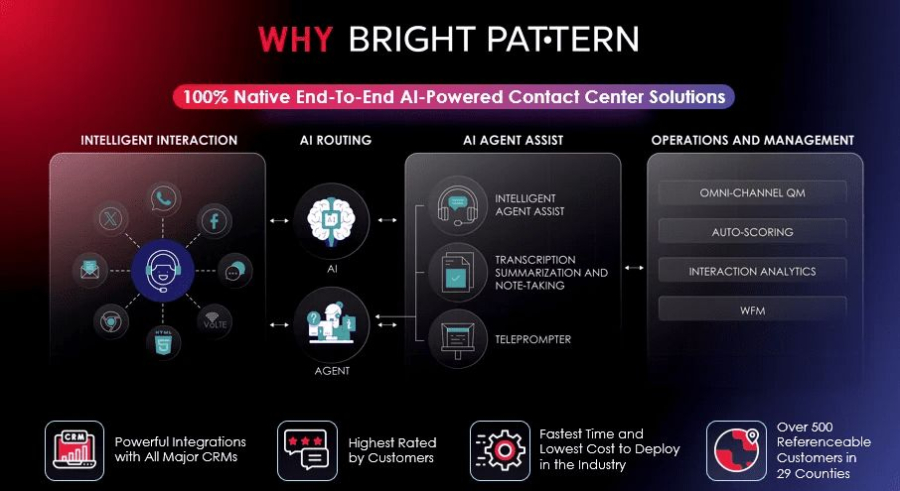
Bright Pattern is trusted by healthcare, finance, retail, and telecom enterprises for intelligent, automated, and commercially optimized AI call center software solutions.
2. 8x8 AI Call Center Software
8x8 provides AI-powered call center software with virtual agents, predictive routing, and speech analytics. Enterprises can automate routine calls, optimize agent workloads, and improve customer engagement.
3. NICE CXone AI Call Center Software
NICE CXone combines AI automation, workforce optimization, and real-time coaching to improve call handling times, agent performance, and overall customer experience.
4. Vonage AI Call Center Software
Vonage offers AI-enabled virtual agents, smart IVR, and real-time agent assistance, helping businesses automate call handling and improve service efficiency.
5. Amazon Connect AI Call Center Software
Amazon Connect uses AI technologies like Amazon Lex and Contact Lens for virtual agent automation, speech analytics, sentiment detection, and cloud-native call center operations.
6. Talkdesk AI Call Center Software
Talkdesk provides AI-powered virtual agents, workflow automation, and real-time agent assistance, enabling faster resolution and better staffing optimization.
7. Zendesk AI Call Center Software
Zendesk automates ticket routing, conversational bots, and knowledge base suggestions to reduce agent workload and improve call resolution times.
8. Microsoft Dynamics 365 AI Call Center Software
Microsoft Dynamics 365 delivers AI-assisted call routing, virtual agent support, and predictive insights, improving efficiency and personalized customer service.
9. Salesforce Service Cloud + Einstein AI Call Center Software
Salesforce Einstein integrates AI into Service Cloud for intelligent call routing, workflow automation, predictive recommendations, and real-time agent guidance.
10. Five9 AI Call Center Software
Five9 provides AI virtual agents, smart IVR, and real-time agent assistance to automate repetitive call handling and optimize enterprise call center operations.
Key benefits of AI call center software
1) Faster resolution and shorter handle times
AI can surface relevant knowledge articles, past cases, and step-by-step guidance while the agent is on the call. That reduces time spent searching and helps agents move confidently toward resolution.
Another high-impact area is automated after-call work. When AI drafts call summaries and tags key topics, agents can wrap up faster and stay available for more customers.
2) Better customer experience (CX) with smarter routing
Routing is where AI often pays off quickly. Instead of sending calls based only on queue availability, AI can route by intent, issue complexity, customer value tier, language, or agent skill match. The result is more customers reaching the right person sooner.
3) More consistent quality across more interactions
Traditional quality assurance may review only a small sample of calls. AI can expand coverage by automatically analyzing larger volumes of interactions for coaching moments, policy adherence, and conversation patterns.
This can support consistent service delivery, especially during seasonal volume spikes or rapid hiring periods.
4) Stronger agent performance and confidence
Agent-assist features act like a real-time co-pilot: suggesting phrasing, showing relevant procedures, and highlighting required disclosures. This benefits new hires and tenured agents alike by reducing cognitive load and reinforcing best practices.
5) Actionable insights from conversations
Call recordings contain valuable customer feedback, but it’s difficult to analyze manually at scale. AI can identify recurring reasons for contact, track sentiment shifts, and surface emerging issues (for example, a new product defect trend or confusing billing language).
These insights can improve not just support, but also product, policy, and marketing.
High-impact AI features to look for
Not every contact center needs every AI feature on day one. Prioritizing the features that match your business goals helps you show value quickly.
Real-time agent assist
- Suggested answers and knowledge articles based on live conversation
- Next-best-action prompts (troubleshooting steps, verification flow)
- Required disclosure reminders and compliance prompts
Automatic call summarization and dispositioning
- Concise summary of the issue, steps taken, and outcome
- Structured tags (reason for contact, resolution code)
- Draft follow-up notes for CRM or ticketing systems
AI-driven routing and prioritization
- Intent detection for accurate queue placement
- Skill-based matching for specialized issues
- Priority handling for urgent or high-value scenarios
Conversation analytics
- Topic clustering (top reasons customers call)
- Sentiment and escalation predictors
- Trend detection over time (what’s rising, what’s declining)
Quality management at scale
- Automated scorecards and evaluation support
- Coaching insights tied to real call moments
- Policy adherence checks and script guidance
AI call center software use cases by team
For customer support leaders
- Reduce wait times through smarter routing and deflection workflows
- Improve consistency with scalable quality monitoring
- Accelerate onboarding with guided agent assist
For operations and workforce management
- Forecast and staff more effectively using contact drivers and trends
- Optimize queue strategy by understanding intent volumes
- Reduce rework with clearer case notes and summaries
For agents
- Spend less time searching and more time helping customers
- Handle complex issues with confidence using step-by-step guidance
- Wrap up calls faster with AI-generated summaries
For QA and training teams
- Coach with specific, time-stamped conversation insights
- Scale evaluations beyond a small call sample
- Standardize expectations with consistent scorecards
For product and CX teams
- Hear the “voice of the customer” in measurable themes
- Spot friction points in policies, UX, or product behavior
- Validate whether fixes reduce contact volume over time
What to measure: KPIs that show AI value
Choosing a few clear metrics helps you prove impact quickly. Common KPIs include:
- Average handle time (AHT) and time spent on after-call work
- First contact resolution (FCR) and repeat contact rate
- Customer satisfaction (CSAT) and post-call survey results
- Abandon rate and average speed of answer (ASA)
- Transfer rate and escalation rate
- QA scores and policy adherence indicators
- Agent sentiment and attrition signals (often supported by internal surveys)
It’s often helpful to establish a baseline for these KPIs before rollout, then compare results over time for the specific queues or teams using AI features.
AI call center software implementation checklist
A structured rollout makes it easier to capture quick wins while building a foundation for long-term gains.
- Define your top outcomes (for example, reduce after-call work, improve FCR, increase CSAT).
- Pick a pilot scope (one queue, one product line, or one region) to test and refine.
- Prepare knowledge content so AI recommendations are accurate and consistent.
- Align on call flows and policies (verification steps, disclosures, escalation rules).
- Integrate key systems such as CRM, ticketing, and knowledge base so agents can act on AI guidance.
- Train agents and supervisors on how to use AI suggestions effectively and when to override them.
- Set up measurement with baseline KPIs and clear reporting cadence.
- Iterate by refining intents, workflows, and knowledge content based on real call outcomes.
- Scale to additional queues once you consistently hit your pilot targets.
A practical feature-to-benefit map
| AI capability | What it does | Business benefit |
|---|---|---|
| Agent assist | Suggests answers and next steps in real time | Faster resolutions and more confident agents |
| Call summarization | Creates post-call notes and structured tags | Less after-call work and better CRM data quality |
| Intent-based routing | Routes calls based on customer needs | Shorter time to reach the right expert |
| Conversation analytics | Finds patterns in topics and sentiment | Clear priorities for process and product improvements |
| Quality automation | Expands monitoring beyond small samples | More consistent service and coaching at scale |
Example scenarios: what success can look like
The following examples are representative scenarios that illustrate how AI call center software can drive results. Actual outcomes depend on your workflows, data quality, and adoption.
Scenario 1: Faster onboarding for a growing support team
A fast-growing company brings on a wave of new agents. With real-time guidance and recommended knowledge articles, new hires follow consistent steps sooner and feel supported during complex calls. Supervisors use conversation insights to coach the most important skills early, improving overall service consistency.
Scenario 2: Reduced repeat contacts in a complex billing queue
In a billing-focused queue, AI helps agents confirm the right customer details, follow a consistent troubleshooting path, and document outcomes clearly. Cleaner summaries and better handoffs reduce repeat calls and improve resolution clarity.
Scenario 3: Proactive issue detection for a product team
Conversation analytics reveal a rising trend in customers mentioning a specific error message. Support leadership flags it quickly to the product team, which shortens the time to identify a root cause and communicate a fix. Meanwhile, agents receive updated guidance to reduce customer frustration during the incident.
How to choose the right AI call center software
Selection is easier when you evaluate solutions against your goals and operational realities. Consider the following criteria:
Fit for your channels and call volumes
Confirm the platform supports the channels you use today (voice, chat, email, messaging) and can scale with seasonal peaks.
Knowledge and workflow alignment
AI performs best when it can reference the right content. Look for strong knowledge-base integration, flexible workflows, and the ability to keep content current.
Agent experience and usability
The best AI is the kind agents actually use. Evaluate how recommendations appear in the desktop, how easy it is to give feedback, and how quickly agents can act on suggestions.
Reporting and insight depth
Prioritize tools that turn conversation data into clear, operationally useful reporting: top contact drivers, emerging themes, and coaching opportunities.
Security and access controls
Look for enterprise-ready controls that match your policies, including role-based access and data handling practices that align with your requirements.
Getting started: a simple plan for quick wins
If you want fast, measurable impact, a common approach is to begin with two or three high-leverage capabilities:
- Call summarization to cut after-call work and improve documentation
- Agent assist for faster answers and better consistency
- Intent-based routing to reduce transfers and speed up resolutions
From there, expand into conversation analytics and automated quality monitoring to build a continuous improvement cycle powered by real customer conversations.
Bottom line
AI call center software helps organizations deliver better service at scale by making every interaction more efficient, consistent, and insightful. With smart routing, real-time agent guidance, automated summaries, and conversation analytics, teams can improve customer satisfaction while supporting agents with tools that make their work easier and more effective.
When you focus on clear goals, start with a targeted pilot, and measure the right KPIs, AI becomes a practical advantage you can feel in daily operations and see in performance results.
